Owning property in Cape Town, Somerset West, Hermanus or any other coastal town, is a dream for many buyers. Spectacular ocean views, strong property demand, and a relaxed coastal lifestyle make it one of South Africa’s most desirable residential markets. However, beneath the beauty of seaside living lies a reality many buyers and homeowners underestimate: coastal properties face structural risks that inland homes often do not.
These risks are frequently hidden. A house may look perfectly sound during a casual viewing, while subtle signs of long-term deterioration are already developing inside walls, foundations, and roof structures. For buyers, sellers, estate agents, and homeowners, understanding these hidden risks can prevent major financial surprises later.
Here are the most important structural risks you should know before buying or maintaining a coastal property in the Western Cape.
1. Salt Air Corrosion – The Silent Structural Enemy
One of the biggest threats to coastal buildings is salt-laden air. Even properties that are not directly on the beachfront are affected.
Sea air carries microscopic salt particles inland, where they settle on steel, metal fixings, reinforcing bars, roof sheeting, balustrades, and structural connectors. Salt attracts moisture and accelerates corrosion significantly faster than inland conditions. Sources describing Hermanus specifically note that salt-laden air, high humidity, and strong winds speed up material deterioration and make corrosion-resistant materials essential.
The problem is that corrosion often starts where you cannot see it:
• Reinforced concrete slabs and balconies
• Steel lintels above windows
• Roof truss connectors
• Retaining wall reinforcement
• Balcony balustrade anchors
• Structural steel supports
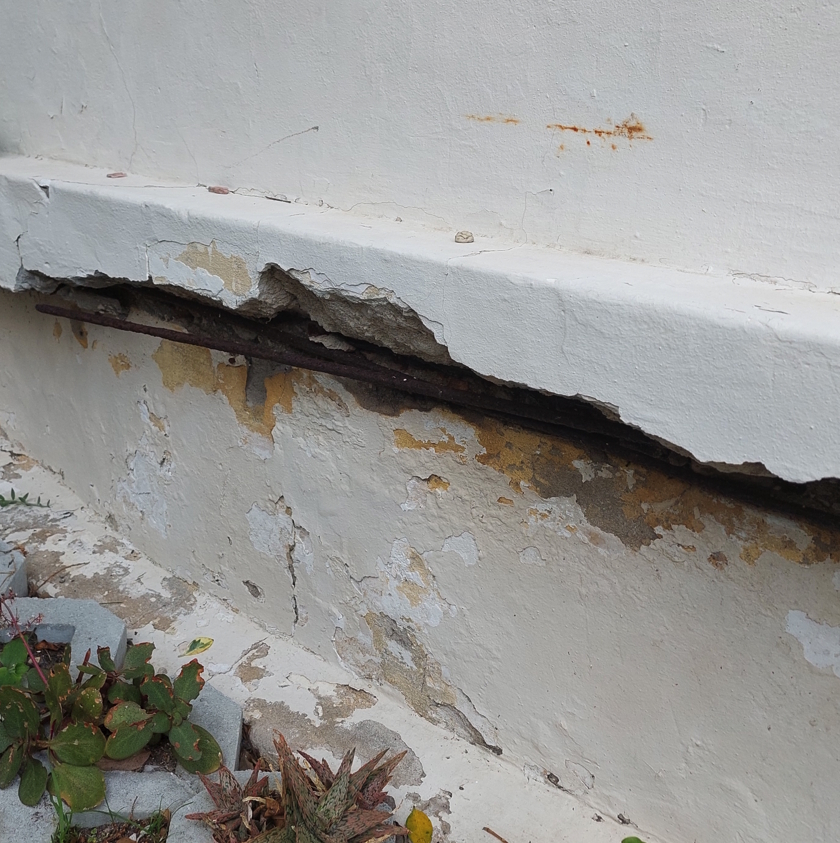
When reinforcing steel rusts, it expands. This creates internal pressure inside the concrete, leading to cracking, spalling (pieces of concrete breaking away), and reduced structural capacity. In the Western Cape, spalling is especially common where moisture and salt exposure combine, and it is often linked to reinforcement corrosion.
A small crack on a balcony edge may therefore indicate much more than cosmetic damage.
2. Hidden Foundation Movement
Many coastal properties are built on sloping sites, variable natural ground, or areas affected by moisture movement. Coastal conditions can worsen foundation instability over time.
Common causes include:
• Poor original soil preparation
• Water ingress around foundations
• Inadequate stormwater drainage
• Ground movement due to moisture changes
• Retaining wall pressure on sloping sites
• Coastal erosion near exposed properties
Foundation movement often appears first as:
• Diagonal cracks near windows and doors
• Uneven floors
• Doors that suddenly stick
• Separation between walls and ceilings
• Cracks reopening after repeated repairs
These are warning signs, not merely cosmetic defects. Poor drainage and erosion around foundations are repeatedly associated with settlement and structural movement in residential buildings.
Many buyers incorrectly assume that patched cracks mean the issue has been resolved. In reality, repainting often hides active movement rather than fixing it.
3. Damp That Is Actually a Structural Problem
In coastal towns, damp is often dismissed as normal. While some moisture-related staining is common, persistent damp can become a serious structural issue.
Moisture penetration affects:
• Timber roof structures
• Suspended timber floors
• Masonry walls
• Concrete reinforcement
• Retaining walls
• Boundary walls
When damp reaches embedded steel or timber elements, deterioration accelerates. Timber can rot, steel can corrode, and concrete can weaken.
The danger is that visible staining may be only the surface symptom. Behind plaster, moisture may already be compromising structural components. Coastal structural inspections commonly identify damp affecting structural elements as a key concern for buyers and sellers.
Not every damp patch is serious—but assuming it is harmless can be expensive.
4. Roof Structures Under Coastal Stress
Roof problems are often overlooked because they are not easily visible during property viewings.
Coastal roofs face:
• Strong prevailing winds
• Salt corrosion of roof fasteners
• Moisture damage to timber trusses
• Rusting roof sheeting
• Failing waterproofing details
• Movement caused by thermal expansion
A roof may appear fine from outside while structural fixings are deteriorating internally.
Corroded brackets, weakened truss plates, and leaking flashings can gradually create larger structural risks. Roof inspections are particularly important for older homes and properties close to the shoreline.
Twice-yearly roof and gutter inspections are strongly recommended for coastal homes because blocked drainage and damaged coverings quickly lead to water damage.
5. Retaining Walls and Boundary Structures
Western Cape coastal properties frequently include retaining walls due to sloping topography. These structures are often ignored until visible failure occurs.
Warning signs include:
• Leaning walls
• Horizontal cracking
• Bulging surfaces
• Poor drainage behind walls
• Water staining
• Separation from adjacent paving
Retaining walls fail gradually and then suddenly.
Water pressure behind a poorly drained retaining wall is one of the most common hidden causes of structural distress. Once movement starts, repairs can be substantial.
Buyers should never assume a retaining wall is “just landscaping.” It may be a major structural element protecting the house itself.
6. Poor Renovations and Unapproved Additions
Many coastal homes have been renovated over time—sometimes badly.
Common hidden problems include:
• Extensions with inadequate foundations
• Walls not properly tied into the original structure
• Altered roof supports
• Removed load-bearing walls
• Poorly constructed decks and balconies
• Unauthorized retaining walls
Cracking at extension junctions is especially common where foundations were not properly connected. Engineers and builders frequently identify additions as the source of major movement problems in residential properties.
A beautiful renovation can hide serious structural shortcuts.
Buyers should always compare what exists physically with approved municipal plans.
7. Corrosion of External Steel Components
Not all structural risks are inside the building.
External components such as:
• Balconies
• Steel stairs
• Pergolas
• Carports
• Gates and supports
• Boundary railings
can deteriorate rapidly in marine environments.
Corrosion weakens connections first, which is often more dangerous than visible surface rust. A balcony bracket may fail long before the full extent of corrosion is obvious.
As one South African Reddit discussion on coastal maintenance put it: “Everything will corrode and rust,” with users specifically recommending aluminium over steel or untreated timber in strong marine exposure zones.
This is particularly relevant for homes close to cliff paths and sea-facing suburbs.
Why Pre-Purchase Structural Inspections Matter
Most visible defects in residential buildings are not catastrophic. Some are cosmetic, some are serviceability issues, and some indicate genuine structural risk.
The challenge is knowing the difference.
That is why buyers should never rely solely on:
• Seller disclosure
• Estate agent opinion
• Fresh paint
• Recently repaired plaster
• General home inspections without engineering input
A professional structural inspection helps determine whether cracks, damp, movement, or corrosion represent normal ageing or a more serious concern.
In high-value coastal property markets like Cape Town, Somerset West or Hermanus, this can save buyers from extremely costly mistakes.
Final Thoughts
Coastal properties offer exceptional lifestyle value, but they demand a higher level of structural awareness.
Salt, moisture, wind, and ground movement do not always cause immediate visible damage. Their effect is gradual, often hidden, and expensive when ignored.
The most dangerous defects are rarely the obvious ones—they are the ones concealed behind neat plaster, fresh paint, and attractive ocean views.
Before buying, selling, or renovating a coastal property in the Western Cape, it is wise to understand what may be happening beneath the surface.
Because in coastal property, what you cannot see is often what costs the most.